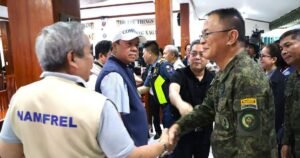
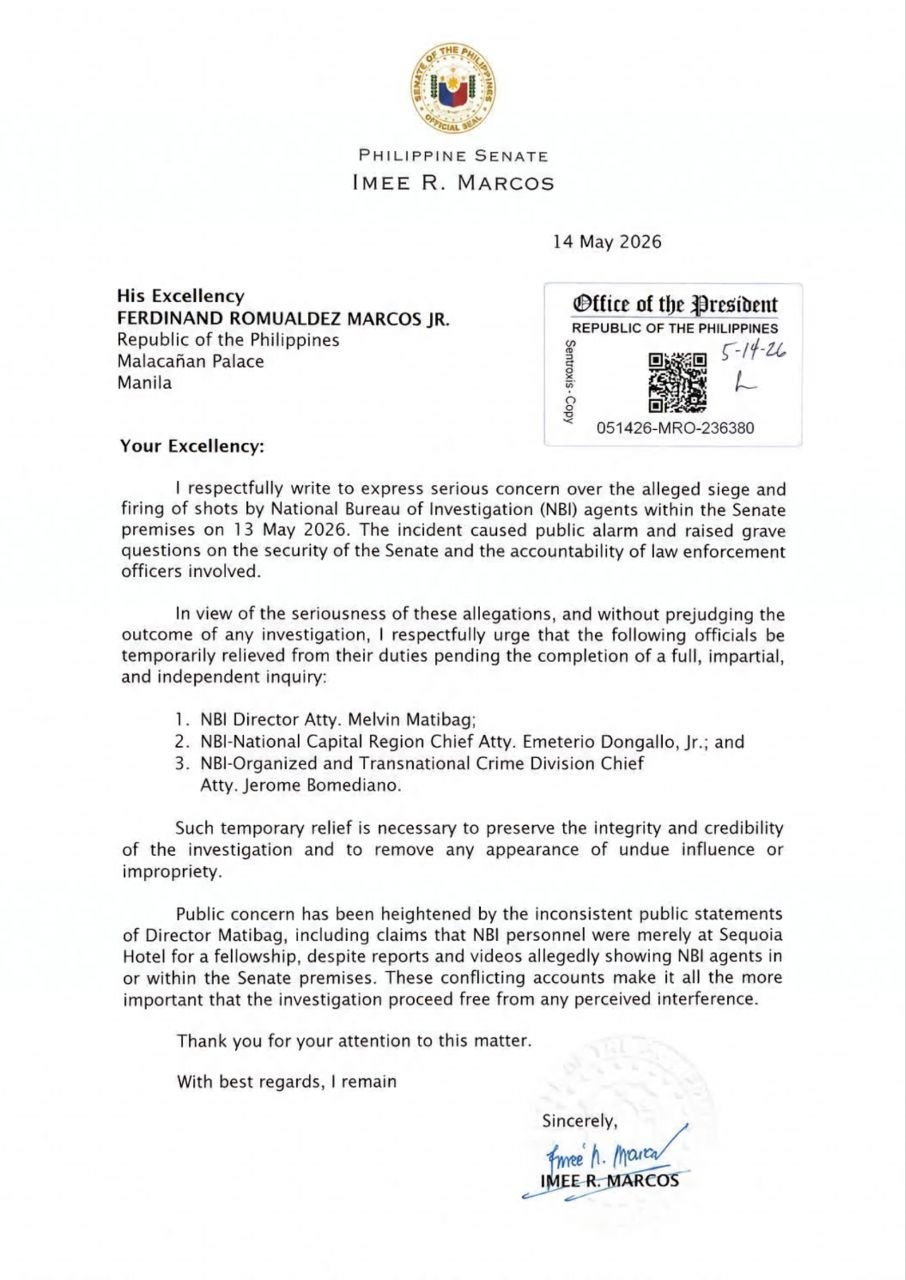
A formal letter to the President. A six-point public defense. And a pointed challenge to the official government narrative. Senator Imee R. Marcos went on the offensive on Thursday, May 14, 2026, demanding the temporary removal of three senior National Bureau of Investigation officials in the wake of what she characterized as an unauthorized armed incursion into the Senate premises the night before.
The letter, addressed formally to “His Excellency Ferdinand Romualdez Marcos Jr.” at Malacañan Palace, named three NBI officials whose relief Senator Marcos said was necessary to protect the integrity of any investigation that would follow: NBI Director Atty. Melvin Matibag, NBI-National Capital Region Chief Atty. Emeterio Dongallo Jr., and NBI-Organized and Transnational Crime Division Chief Atty. Jerome Bomediano.
Temporary Relief Sought to Protect Inquiry’s Credibility
In the letter dated May 14, 2026, Senator Marcos argued that allowing the three named officials to remain in their posts while an investigation was ongoing would raise serious questions about the impartiality of the process. According to Senator Marcos, “Such temporary relief is necessary to preserve the integrity and credibility of the investigation and to remove any appearance of undue influence or impropriety.”
She was careful to frame her demand not as a prejudgment of guilt, but as a precautionary procedural step — one she said was standard practice in cases where those who are subjects of inquiry retain operational authority over the very agencies involved.
Central to her concern was what she called the “inconsistent public statements” of NBI Director Matibag. The director had reportedly claimed that NBI personnel were present near the Senate compound that evening for a fellowship gathering at the adjacent Sequoia Hotel — a characterization that Senator Marcos said was flatly contradicted by reports and video footage that allegedly showed NBI agents operating inside or along the perimeter of the Senate complex itself.
“These conflicting accounts make it all the more important that the investigation proceed free from any perceived interference,” Senator Marcos wrote, according to the letter she released publicly.
Senate Security Fired First, but Marcos Argues Self-Defense
In a separate six-point public statement released under the hashtag #IMEEsolusyon on May 14, Senator Marcos acknowledged a fact that could have been politically damaging — that Senate security personnel under the Office of the Sergeant-at-Arms (OSAA) fired the first shot during the May 13 incident. However, she argued the circumstances left the OSAA with little choice.
According to Senator Marcos’s account, NBI agents had entered the Senate grounds without authorization, had allegedly breached access by drilling through a wall connecting from the adjacent Government Service Insurance System (GSIS) building, and had refused multiple demands to put down their long arms and live ammunition. The OSAA’s initial discharge, she contended, was a single warning shot — and she claimed that several volleys subsequently came from the NBI side.
“They were clearly assaulting the Senate, and it was mere self-defense for the Senate to fire a single warning shot, after which several volleys were fired by the NBI, further justifying Senate security’s single shot,” Senator Marcos stated in her six-point public assessment.
If No Arrest Was Planned, Why Were They There?
One of the sharpest questions Senator Marcos raised in her public statement went to the heart of the NBI’s stated rationale for being near the Senate that evening. She pointed to NBI Director Matibag’s own publicly stated position — that there were “instructions not to arrest” Senator Ronald “Bato” dela Rosa — and turned that statement into a challenge.
“If they were not going to arrest Bato, what was the NBI doing at the Senate? Why did they not coordinate with the Senate President and the OSAA, as they said they had done in past operations?” Senator Marcos asked in her statement.
She further questioned why NBI agents were positioned near the upper chamber at all, given that the administration itself had not yet resolved the legal standing of any warrant against Senator Dela Rosa, with the matter reportedly still pending a resolution from the Supreme Court at the time of the incident.
ICC Jurisdiction, Interpol, and the Question of a Valid Warrant
Senator Marcos also pressed on what she described as the absence of a legally valid and officially recognized warrant against Senator Dela Rosa. She tied this argument directly to the Marcos administration’s own previously stated position that the Philippines does not recognize the jurisdiction of the International Criminal Court.
She drew a comparison with the earlier case involving former President Rodrigo Duterte, noting that in that instance, the Philippine government’s process ran through Interpol — not the ICC acting unilaterally. As of her statement on May 14, Senator Marcos said no public report had confirmed the existence of an active Interpol request involving Senator Dela Rosa.
Senator Marcos cited Department of the Interior and Local Government Secretary Juanito Victor “Jonvic” Remulla, who she said clarified during his appearance at the Senate on the night of May 13 that any ICC-related matter must pass through the Philippine Center on Transnational Crime (PCTC) and local courts before any enforcement action could be taken.
“How can there be obstruction of justice if there is no valid and officially recognized warrant against Bato?” Senator Marcos asked pointedly in her statement, a question she said remained unanswered by the executive branch as of May 14.
She added that no senator had personal knowledge of any specific act imputed to Senator Dela Rosa, and that, to her knowledge, no pending case existed in Philippine courts against him for crimes against humanity.
How the May 13 Crisis Began
The chain of events that led to Senator Marcos’s letter began on the evening of Wednesday, May 13, 2026, when reports began circulating that law enforcement authorities might attempt to apprehend Senator Dela Rosa at the Senate compound in Manila. Dela Rosa faces an arrest warrant issued by the International Criminal Court in connection with his role as Philippine National Police chief during the Duterte administration’s anti-drug campaign.
The Senate was placed on lockdown. Gunshots were subsequently reported on the second floor of the Senate building, setting off widespread alarm and raising immediate constitutional questions about the arrest of a sitting senator on legislative premises.
In a recorded video message released late on May 13, President Ferdinand Marcos Jr. denied any government involvement, stating that no soldier, police officer, or NBI agent from outside had entered the Senate compound, and that no orders had been issued to arrest Dela Rosa. The President’s denial stood in direct tension with the accounts circulating from inside the Senate, including those from Senator Imee Marcos herself.
Dual Investigations Underway, Key Questions Unresolved
By May 14, 2026, both the Senate and the Philippine National Police had announced the launch of separate, parallel investigations into the events of the night of May 13, according to statements from both institutions. The dual-track inquiry itself raised questions about coordination and potential conflicts of interest — concerns that Senator Marcos’s letter to the President appeared designed to preempt by calling for the removal of the named NBI officials before any investigation gained momentum.
As of the time of writing, it remained unclear whether President Marcos had responded to the letter or taken any action regarding the three NBI officials named by his sister. The Supreme Court’s resolution on the legal question of any potential warrant against Senator Dela Rosa was also still pending, with a 72-hour window for government response reportedly in effect.
The incident has significantly escalated political tensions in Manila, focusing public attention on the boundaries between executive law enforcement authority and the constitutional protections surrounding the legislative branch — and on the still-unresolved question of whether a legally recognized basis for action against Senator Dela Rosa exists under Philippine law.
Source: Originally reported by the Philippine Senate Public Information Office and wire reports.